



Repurpose Content for Twitter: A Practical Growth Strategy
If you’ve been struggling to post consistently, you’re not alone. Most creators underestimate how powerful repurpose content for Twitter can be when done strategically. In fact, one of the fastest ways to grow on X (Twitter) today is not by creating more content—but by reworking what you already have.
Many accounts burn out trying to constantly publish new ideas, when the smarter move is to apply a structured how to repurpose content for Twitter workflow that turns blogs, videos, newsletters, and even old posts into fresh, high-performing tweets.
Let’s break down how this works in real practice.
Why Content Repurposing Works So Well on Twitter
Twitter is not a “create once, forget forever” platform. Tweets have a short lifespan, which means even your best content disappears quickly.
This is why how to repurpose content for Twitter is such a powerful skill. Instead of betting everything on one post, you distribute the same idea in multiple formats.
A strong content repurposing strategy for Twitter allows you to:
- Extend the lifespan of your ideas
- Reach new audiences at different times
- Test multiple hooks for the same message
- Reduce daily content pressure
In other words, it’s not about doing more—it’s about extracting more value from what you already created.
Turning Long-Form Content into Tweet Threads
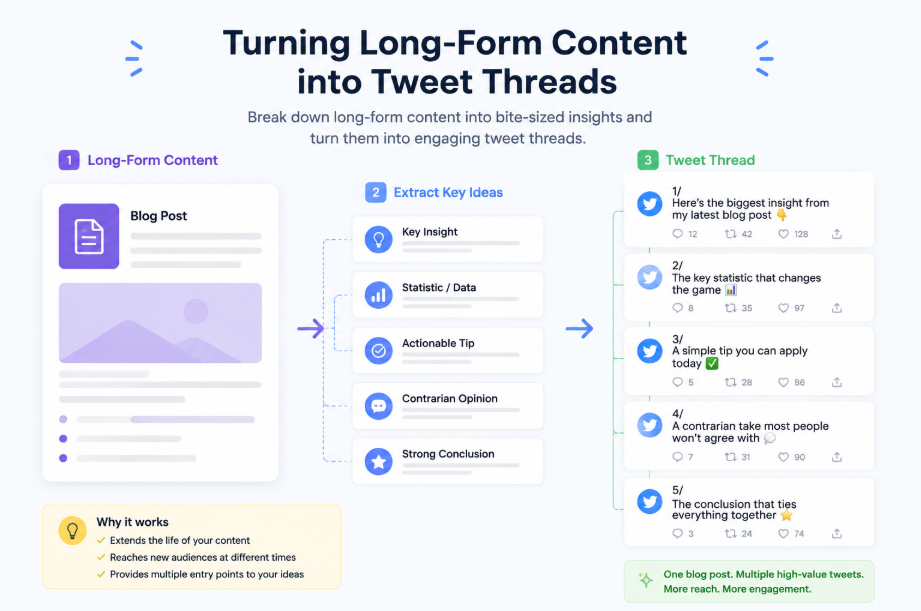
One of the easiest ways to start how to repurpose content for Twitter is by breaking down long-form content into bite-sized insights.
For example:
- A blog post becomes a thread
- A thread becomes individual tweets
- A tweet becomes multiple variations
This is where turn blog posts into tweets becomes especially useful. Instead of copying and pasting, you extract:
- Key insights
- Contrarian opinions
- Data points
- Actionable steps
A well-built content repurposing strategy for Twitter ensures every blog you write can fuel 10–30 tweets without sounding repetitive.
Creators who master this approach rarely run out of content ideas.
Extracting Micro-Content from Existing Assets
Another underrated method for repurpose content for Twitter is micro-extraction.
This means pulling small, standalone ideas from larger content pieces.
For example:
- A single paragraph becomes a tweet
- A statistic becomes a hook
- A conclusion becomes a bold statement
When applying how to repurpose content for Twitter, think of every piece of content as a “content mine.” You’re not rewriting—you’re extracting.
This is also where many marketers use Twitter content recycling to keep their feeds active without constantly producing new material.
Building a Repeatable Content System
If you want long-term growth, you need more than random repurposing—you need structure.
A strong content repurposing strategy for Twitter usually includes:
- Source library (blogs, videos, notes)
- Extraction process (key ideas → tweet ideas)
- Formatting system (threads, hooks, standalone tweets)
- Scheduling workflow
When you consistently apply how to repurpose content for Twitter, your workflow becomes predictable and scalable.
Instead of asking “what should I post today?”, you simply ask “what should I extract today?”
That shift alone changes everything.
Common Mistakes When Repurposing Content
Even though repurpose content for Twitter is simple in concept, many people do it wrong.
Here are common mistakes:
- Copying content without adapting tone
- Reposting the same message without variation
- Ignoring platform-native writing style
- Overloading tweets with blog-style formatting
Twitter content must feel native. That’s why tweet optimization from existing content is critical. You’re not just reusing content—you’re reshaping it into something that fits the platform’s fast-paced environment.
A good how to repurpose content for Twitter workflow always prioritizes clarity, brevity, and hook strength.
Scaling Content Without Burnout
One of the biggest benefits of content repurposing strategy for Twitter is sustainability.
Instead of constantly chasing new ideas, you build a system where:
- One blog = multiple threads
- One thread = multiple tweet variations
- One tweet = multiple repost angles
This approach dramatically reduces content fatigue while increasing output.
Many advanced creators rely heavily on Twitter content recycling because it allows them to maintain high posting frequency without creative exhaustion.
It’s not about being more creative—it’s about being more efficient with creativity.
Using Tools to Speed Up Repurposing
Manual repurposing works, but it can be slow. This is where automation tools and AI workflows become useful.
A structured how to repurpose content for Twitter system often includes:
- AI-assisted rewriting
- Thread generation from blogs
- Hook variations testing
- Bulk tweet creation
When combined correctly, your content repurposing strategy for Twitter becomes nearly automated.
This is also where advanced tools like TweetAttacksPro come into play, helping marketers scale content distribution and engagement workflows more efficiently.
If you’re serious about growth on X, mastering repurpose content for Twitter is no longer optional—it’s foundational.
Instead of constantly creating new ideas, the smarter approach is learning how to repurpose content for Twitter in a structured, repeatable way. Whether you’re turning blog posts into tweets or building a full content repurposing strategy for Twitter, the goal remains the same: maximize output from minimal input.
And once you adopt consistent Twitter content recycling, you’ll realize content creation was never your real bottleneck—distribution was.
If you want to accelerate your workflow even further, you can also try the free version of TweetAttacksPro, which helps streamline Twitter automation and content execution for growth-focused users.